
Hall County Parole Versus Probation
Parole and probation can both place a person under rules in the community, but their source is different. The State Board of Pardons and Paroles decides parole for an eligible Georgia state inmate. The Georgia Department of Community Supervision, or DCS, then supervises parolees in the community. A judge imposes probation. For an adult felony case, that sentence generally comes from Superior Court and DCS provides community supervision.
A Hall County Jail release does not prove that either form of supervision began. Someone may leave on bond while a case remains pending. Another person may complete a local jail term with no supervision to follow. A person returning to Hall County from state prison may instead be on parole. The order, parole record, or DCS record identifies the real status.
| Point | Parole | Probation |
|---|---|---|
| Who authorizes it | State Board of Pardons and Paroles | Sentencing court |
| When it begins | After release from state custody | As directed by the sentence |
| Public starting point | Parolee Search or TPM Lookup | Hall County court docket and DCS |
| Who supervises | DCS | DCS for adult felony probation |
Verify Hall County Release Supervision
Start with the custody path, not a broad name search. A person released from Hall County Jail may have a pending local case, a probation sentence, or no supervision. A person leaving Hall County Correctional Institution is a state offender, so GDC and Parole Board records are more useful. Matching the full name with an official number reduces mistakes between people who share a name.
- Search the Georgia Parolee Search by first and last name. Race, case number, UPI number, or GDC ID can narrow the result.
- If the person remains in state custody, use the Inmate TPM Lookup. It accepts a six-digit inmate number, GDC ID, or personal data.
- Check the Hall County online docket for a probation order, split sentence, revocation, or later case action.
- Use the DCS field-office locator by county or judicial circuit. Confirm the office rather than assuming the closest map result is assigned.
- Ask the correct agency to confirm a detail that the public result does not show. Parole decisions belong to the Board; reporting and field-office questions belong to DCS.
Hall County Parole Status Tools
The TPM Lookup and Parolee Search answer different points in time. A Tentative Parole Month is the month when the Board expects to complete final review and, if appropriate, set a parole release date. It is not a final release promise. Misconduct or failure to finish required programming can postpone or cancel it. The Parolee Search is the stronger public tool after a person has actually been released on parole.
Georgia parole is discretionary. An eligible inmate is considered automatically and does not file a parole application. A majority of the Board must vote to grant parole. The Board may establish a future TPM or deny parole in a non-life case, and it may reconsider a prior decision before release. Under O.C.G.A. § 42-9-45, many felony cases reach eligibility after nine months or one-third of the sentence, whichever is greater, unless another law applies.
The official Board meeting notices should not be read as individual case calendars. Monthly public meetings concern operations, policy, updates, and presentations. Offender cases are not decided at those meetings. Official Board materials state that members vote on parole cases electronically each day.
The Georgia parole process source shown below explains how case review and voting work. It helps distinguish a Board process from a county court hearing.
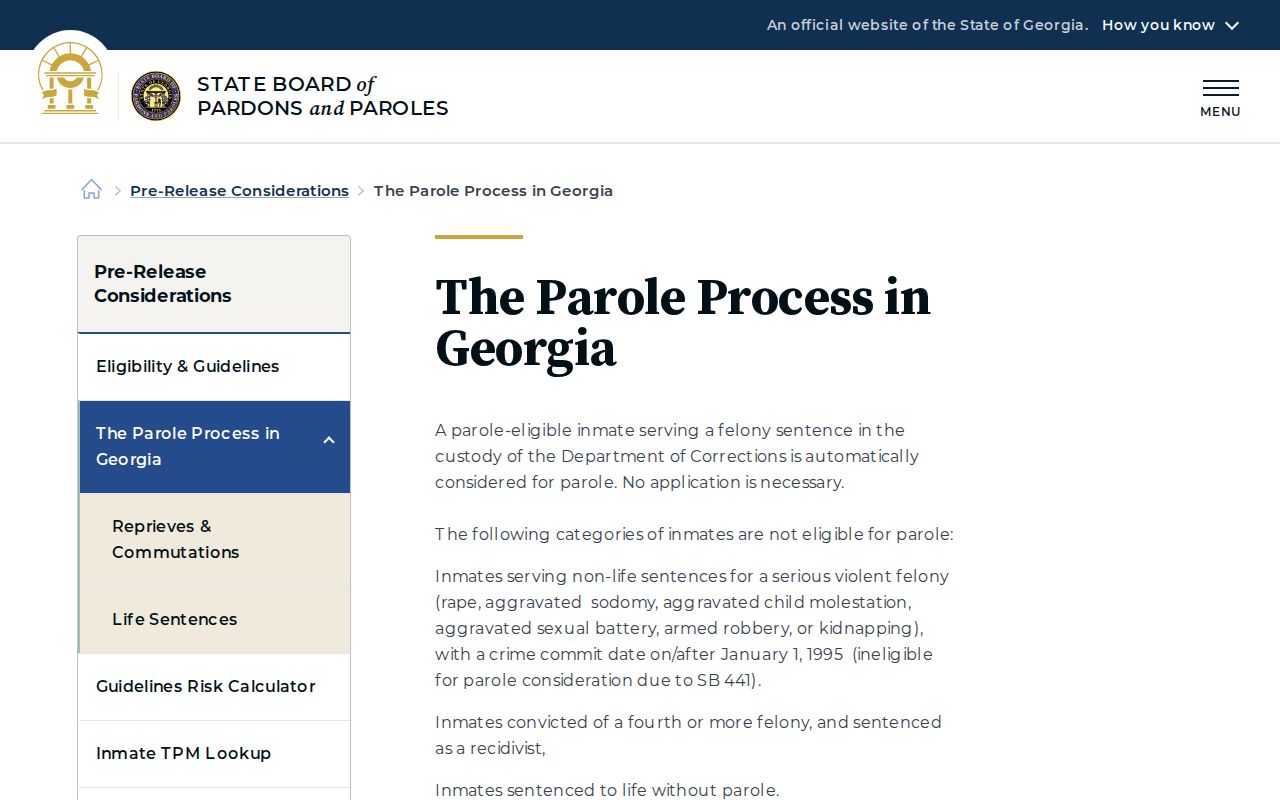
The image is a source view, not a live case result. Use the TPM or parolee application for the named person.
Hall County DCS Supervision Contacts
DCS supervises felony probationers and parolees after release. It also covers people who received a probated or split sentence from a Georgia court. A split sentence combines confinement with probation. This explains why two Hall County residents may report to the same agency even though only one left state prison on parole.
Field office: confirm through the county or circuit locator
Central phone: 678-783-4337
General field-office hours: Monday through Friday, 8:00 a.m. to 5:00 p.m. Eastern
DCS central contact information is useful for routing, but the assigned officer and field office control day-to-day reporting. The public locator is the safest way to identify the current office. The central phone should not be treated as proof of a person's supervision status.
The DCS office locator pictured below is the official route for office details.
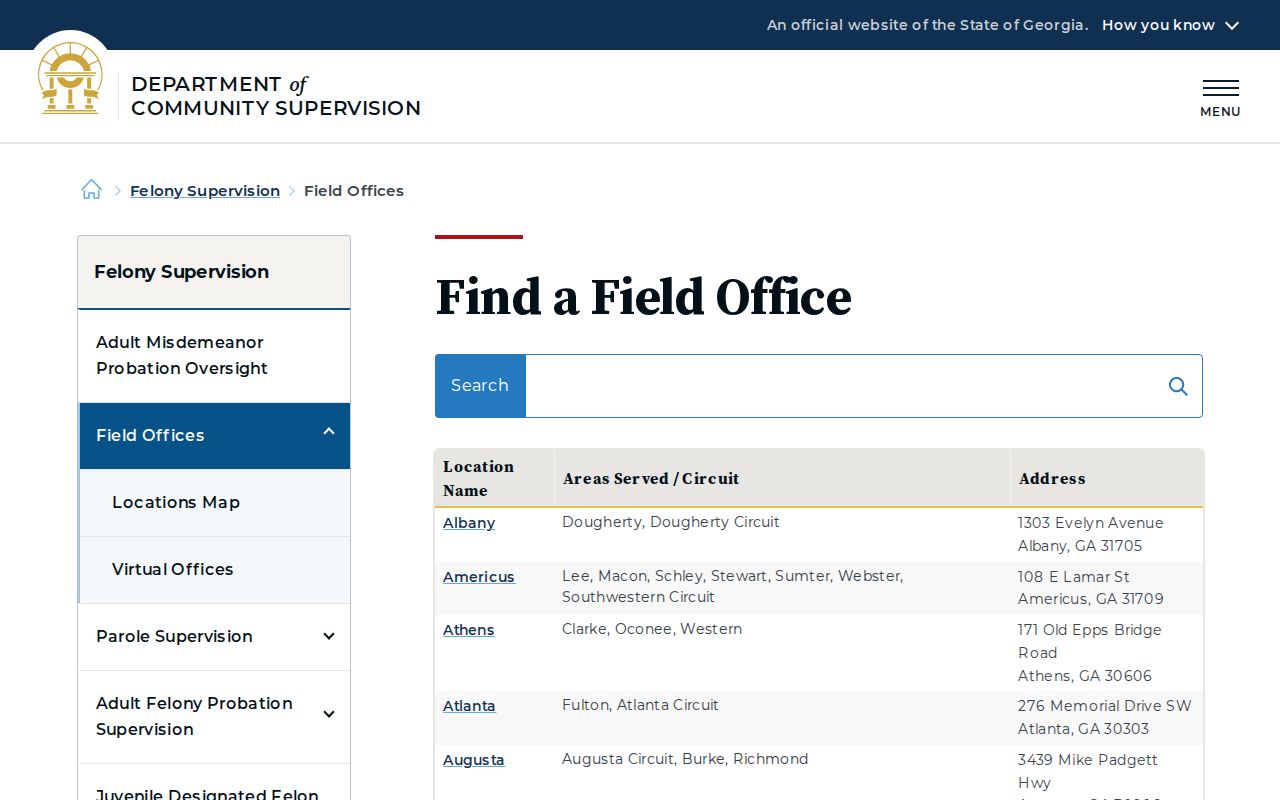
Check the live locator because assignments and office details can change.
Hall County Supervision Terms
Official records use short terms that can change the meaning of a result. These definitions keep custody, release, and supervision separate.
- Parole
- Conditional release from a state-prison sentence by the Parole Board, followed by DCS supervision.
- Probation
- A court-ordered sentence served under community rules, sometimes after a jail or prison term.
- Split sentence
- A sentence with a confinement part and a probation part.
- Absconder
- A person alleged to have stopped reporting or left supervision without permission. It may lead to a warrant, but the agency record controls.
- Revocation
- A court or Board action that can change or end community supervision after an alleged violation.
- Discharge
- Official completion or termination of supervision. Release from custody alone is not discharge.
Hall County Violations and Discharge
Supervision conditions vary by the actual order. They may address reporting, travel, treatment, programs, payments, or other conduct, but a public search does not replace the order. A missed report also should not be labeled an absconder finding without official confirmation. DCS, the Parole Board, or the court records a violation, warrant, revocation, or change in status.
Parole and probation also end in different ways. A parolee may reach the end of the sentence or receive an official discharge. A probationer may complete the term, obtain early termination when authorized, or return to court after a violation. The Hall County court docket can preserve probation and revocation activity after a jail entry disappears. The Parolee Search and DCS records cover the state supervision path.
For the underlying local custody event, the full Hall County released-inmate search and records path is on the Hall County released inmates home page. Request the release record from the Sheriff's Office if the question is when or why local jail custody ended.
Note: A supervision record may remain relevant after release, while the Hall County current inmate list no longer shows the person.
Hall County REACT Reentry
Hall County has a local bridge between state release and community supervision. The Hall County Correctional Institution operates REACT for Hall and Dawson residents returning to the Northeastern Judicial Circuit from state prison. The county describes intensive work before release on parole or probation. That focus makes REACT distinct from a public parole lookup or a DCS field office.
Participation does not prove that parole was granted. It also does not replace the sentencing order. Use the TPM Lookup before release, the Parolee Search after a parole release, and DCS for the assigned community office. The program supplies local reentry context, while those official records supply status.
Hall County Release Property Rules
Hall County requires an inmate to have one set of street clothes at the facility for release or transfer. The inmate property rules also state that a state inmate's personal property must be collected within ten working days after conviction or state-inmate status. Pickup is available Monday through Friday from 8:00 a.m. to 4:00 p.m. Property may be disposed of if it is not collected in time.
These rules matter because transfer and community release are not the same event. Street clothes may be used for either. A property deadline may begin when a person becomes a state inmate even though parole or probation has not begun. Confirm the custody destination through GDC, the court, or the Hall County release record before treating a change as community release.